
The efficacy of sketching techniques as a visual scaffolding tool for enhancing mathematical word problem-solving among lower primary students
##plugins.themes.bootstrap3.article.sidebar##
##plugins.themes.bootstrap3.article.main##
Abstract
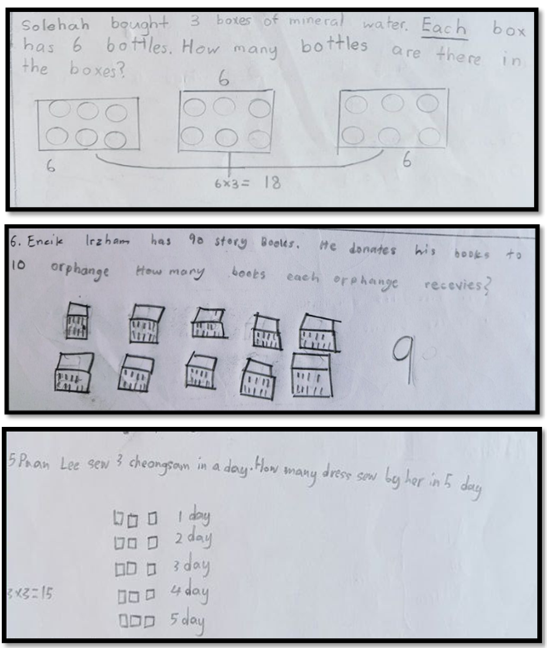
Mathematical word problem-solving remains a significant challenge for early primary students due to the abstract nature of linguistic information and cognitive load constraints. This study investigates the effectiveness of the Sketching Technique in enhancing the mathematical achievement of Year 2 students, with a specific focus on word-problem solving involving basic arithmetic operations. A quasi-experimental research design was employed involving 60 Year 2 students from a primary school in the Northeast District of Penang. The participants were divided into a treatment group (n=30) that used the Sketching Technique and a control group (n=30) that followed conventional teaching methods. The research instrument was an achievement test consisting of 10 word-problem questions, with a total score of 10 marks. The test's internal consistency reliability was acceptable (Kuder-Richardson Formula 20 = 0.81). Data were collected using pre-test and post-test instruments and analyzed using paired and independent-samples t-tests. Findings revealed a significant improvement in the treatment group, with the mean score increasing markedly from 2.33 on the pre-test to 9.53 on the post-test. Conversely, the control group showed minimal improvement, with mean scores rising from 2.30 to only 2.90. Statistical analysis confirmed a significant difference between the two groups, with the treatment group demonstrating more consistent performance as evidenced by a reduction in standard deviation from 1.73 to 0.51. Furthermore, the effect size (Cohen's d) was calculated to be 5.65, indicating very large practical significance of the intervention. These results suggest that integrating visual-based pedagogical innovations is crucial for improving numeracy outcomes and fostering critical thinking in early primary education.
##plugins.themes.bootstrap3.article.details##

This work is licensed under a Creative Commons Attribution-ShareAlike 4.0 International License.
The author is responsible for acquiring the permission(s) to reproduce any copyrighted figures, tables, data, or text that are being used in the submitted paper. Authors should note that text quotations of more than 250 words from a published or copyrighted work will require grant of permission from the original publisher to reprint. The written permission letter(s) must be submitted together with the manuscript.References
Asmara, A. S., Yusuf, Y., Prawiyogi, A. G., Zonyfar, C., Alhamssyah, M. A., & Alfarid, M. N. (2026). Profiling numeracy literacy among ninth-grade students: Empirical evidence from junior secondary education. Infinity Journal, 15(1), 291–318. https://doi.org/10.22460/infinity.v15i1.p291-318
Cartwright, K. (2024). Interpreting young children’s multiplicative strategies through their drawn representations. Mathematics Education Research Journal, 36(2), 367–397. https://doi.org/10.1007/s13394-023-00450-4
Chua, Y. P. (2011). Kaedah dan statistik penyelidikan: Kaedah penyelidikan. McGraw-Hill Education.
Creswell, J. W., & Creswell, J. D. (2018). Research design: Qualitative, quantitative, and mixed methods approaches (5th ed.). Sage publications.
DeDecker, S., Vale, J., Gordon, K., & Clemmer, R. (2023). STEM student perceptions of problem-solving skill development and the importance of memorization in problem-solving courses. In Proceedings of the Canadian Engineering Education Association (CEEA), (pp. 149). https://doi.org/10.24908/pceea.2023.17125
Ekawati, R., Fitriana, L. D., Prahmana, R. C. I., Mahdiannur, M. A., Nisa, K., & Sa’diyah, M. (2026). The dynamics of behavioral pattern in collaborative problem-solving among Indonesian preservice mathematics teachers. Infinity Journal, 15(1), 115–132. https://doi.org/10.22460/infinity.v15i1.p115-132
Fuchs, L. S., Fuchs, D., & Prentice, K. (2004). Responsiveness to mathematical problem-solving instruction. Journal of Learning Disabilities, 37(4), 293–306. https://doi.org/10.1177/00222194040370040201
Gansemer-Topf, A. M., Paepcke-Hjeltness, V., Russell, A. E., & Schiltz, J. (2021). “Drawing” your own conclusions: Sketchnoting as a pedagogical tool for teaching ecology. Innovative Higher Education, 46(3), 303–319. https://doi.org/10.1007/s10755-020-09542-6
Gholami, H. (2023). Performance of Malaysian foundation level students in mathematical problem solving as well as gender comparison. Mathematics Teaching Research Journal, 15(2), 104–120.
Hahn, L., & Klein, P. (2023). Analysis of eye movements to study drawing in the context of vector fields. Frontiers in Education, 8, 1162281. https://doi.org/10.3389/feduc.2023.1162281
Harisman, Y., Hafizatunnisa, H., Asra, A., Armiati, A., Suherman, S., Adnan, M., Purnomo, Y. W., Sumarni, P., & Syaputra, H. (2026). An analysis of Indonesian and Malaysian postgraduate students’ mathematical problem-solving behavior using research skill development framework. Infinity Journal, 15(2), 571–594. https://doi.org/10.22460/infinity.v15i2.p571-594
Hegarty, M., & Kozhevnikov, M. (1999). Types of visual–spatial representations and mathematical problem solving. Journal of educational psychology, 91(4), 684–689. https://doi.org/10.1037/0022-0663.91.4.684
Iilonga, H. K., & Ogbonnaya, U. I. (2023). Grade 10 Namibian learners' problem-solving skills in algebraic word problems. Infinity Journal, 12(2), 275–290. https://doi.org/10.22460/infinity.v12i2.p275-290
Jitendra, A. K., Petersen-Brown, S., Lein, A. E., Zaslofsky, A. F., Kunkel, A. K., Jung, P.-G., & Egan, A. M. (2015). Teaching mathematical word problem solving: The quality of evidence for strategy instruction priming the problem structure. Journal of Learning Disabilities, 48(1), 51–72. https://doi.org/10.1177/0022219413487408
Kaur, B., & Yeap, B. H. (2009). Mathematical problem solving in Singapore schools. In B. Kaur, B. H. Yeap, & M. Kapur (Eds.), Mathematical problem solving: Yearbook 2009 (pp. 3–13). Association of Mathematics Educators. https://doi.org/10.1142/7335
Kortemeyer, G. (2023). Writing virtual reality teaching resources. The Physics Teacher, 61(2), 107–109. https://doi.org/10.1119/5.0067963
Lane, D. (2017). Drawing and sketching: Understanding the complexity of paper-pencil interactions within technology education. In M. de Vries (Ed.), Handbook of Technology Education (pp. 1–18). Springer. https://doi.org/10.1007/978-3-319-38889-2_32-1
Lewis, M., Sturdee, M., Hoang, T., Gamboa, M., & Jain, P. (2023). SketCHI 5.0: Diversity & accessibility at the core of sketching in HCI. In Extended Abstracts of the 2023 CHI Conference on Human Factors in Computing Systems, (pp. 1–3). https://doi.org/10.1145/3544549.3583182
Liu, J., Keane, T., Sun, D., Yang, Y., & Yang, Y. (2025). Design and evaluation of ChatGPT-MWPS: An AI-enhanced learning system for improving primary students’ mathematical word problem solving. Smart learning environments, 12(1), 68. https://doi.org/10.1186/s40561-025-00419-9
Maharani, S., Kholid, M. N., Pradana, L. N., & Nusantara, T. (2019). Problem solving in the context of computational thinking. Infinity Journal, 8(2), 109–116. https://doi.org/10.22460/infinity.v8i2.p109-116
McNeil, N. M., Jordan, N. C., Viegut, A. A., & Ansari, D. (2025). What the science of learning teaches us about arithmetic fluency. Psychological Science in the Public Interest, 26(1), 10–57. https://doi.org/10.1177/15291006241287726
Mohd Yusof, K. (2005). Kaedah penyelidikan pendidikan. Prentice Hall.
Morden-Snipper, D. R., Dai, T., Booth, J. L., Chang, B. L., Cromley, J. G., & Newcombe, N. S. (2015). Cognitive factors and representation strategies in sketching math diagrams. In Proceedings of the 37th Annual Meeting of the Cognitive Science Society, (pp. 1637–1642).
Murtafiah, W., Lestari, N. D. S., Yahya, F. H., Apriandi, D., & Suprapto, E. (2023). How do students' decision-making ability in solving open-ended problems? Infinity Journal, 12(1), 133–150. https://doi.org/10.22460/infinity.v12i1.p133-150
Musrikah, M., Asmarani, D., & Handoko, A. I. (2023). Karakteristik representasi visual, verbal, dan simbolis matematis mahasiswa calon guru sekolah dasar [Characteristics of visual, verbal, and symbolic mathematical representations of prospective elementary school teachers]. AKSIOMA: Jurnal Program Studi Pendidikan Matematika, 12(3), 2847–2861. https://doi.org/10.24127/ajpm.v12i3.6693
Nasir, N. A. M., Singh, P., Narayanan, G., Han, C. T., Rasid, N. S., & Hoon, T. S. (2021). An analysis of undergraduate students ability in solving non-routine problems. Review of International Geographical Education Online, 11(4), 861–872.
Nasution, S. H., Jupri, A., & Dasari, D. (2025). Students’ anxiety level in learning mathematics and its influencing factors. In The 5th International Conference on Mathematics and its Applications (ICoMathApp) 2024: Innovations in Mathematics and Mathematics Education for Sustainable Futures, (Vol. 3446, pp. 030044). https://doi.org/10.1063/5.0309365
Özcan, Z. Ç., & Doğan, H. (2018). A longitudinal study of early math skills, reading comprehension and mathematical problem solving. Pegem Eğitim ve Öğretim Dergisi, 8(1), 1–18. https://doi.org/10.14527/pegegog.2018.001
Paivio, A. (1991). Dual coding theory: Retrospect and current status. Canadian Journal of Psychology / Revue canadienne de psychologie, 45(3), 255–287. https://doi.org/10.1037/h0084295
Piaget, J. (1976). Piaget’s Theory. In B. Inhelder, H. H. Chipman, & C. Zwingmann (Eds.), Piaget and His School: A Reader in Developmental Psychology (pp. 11–23). Springer Berlin Heidelberg. https://doi.org/10.1007/978-3-642-46323-5_2
Sartika, D., Mutmainna, A. A. A., Abdullah, H., & Tawil, M. (2019). Preliminary research on prospective teacher’s ability in understanding the physics problems by sketching The 8th National Physics Seminar 2019,
Setambah, M. A. B., Adnan, M., Zaini, S. H., Mujiasih, M., Hidayat, R., Ibrahim, M. A., & Hanazono, H. (2024). Impact of "Donkey", "Snap" dan "King" (DSK) non-digital gamification cards on fourth-grade students' math performance in fractions. Infinity Journal, 13(1), 175–196. https://doi.org/10.22460/infinity.v13i1.p175-196
Si, L. S., & Huan, C. (2024). Effectiveness of visualisation integrated problem solving approach on improving grade three Malaysian students’ arithmetic word problem solving ability. International Journal of Academic Research in Progressive Education and Development, 13(4), 3153–3162. https://doi.org/10.6007/IJARPED/v13-i4/22953
Suprotun, S., & Suparman, S. (2019). Development learning design lift material flap with character education to improve problem solving abilities. International Journal of Scientific and Technology Research, 8(12), 2806–2810.
Sweller, J. (1988). Cognitive load during problem solving: Effects on learning. Cognitive Science, 12(2), 257–285. https://doi.org/10.1016/0364-0213(88)90023-7
van Garderen, D. (2007). Teaching students with LD to use diagrams to solve mathematical word problems. Journal of Learning Disabilities, 40(6), 540–553. https://doi.org/10.1177/00222194070400060501
Varatharaju, S., & Setambah, M. A. B. (2023). Perlaksanaan kbat dengan penggunaan kaedah jadual dalam penyelesaian masalah matematik tahun empat [Implementation of HOTS using the table method in year four mathematical problems]. Jurnal Pendidikan Sains Dan Matematik Malaysia, 13(1), 22–30.
Wahyuni, R., Suwanto, F. R., Sthephani, A., & Ahyan, S. (2025). Students’ obstacles in solving algebra form problems viewed from mathematical problem-solving ability. Infinity Journal, 14(3), 587–606. https://doi.org/10.22460/infinity.v14i3.p587-606
Wei, L. Y., Gabda, D., Ping, N. P. T., & Mun, H. C. (2025). Challenges and opportunities: A comparison of PISA 2022 mathematics performance in Malaysia and other ASEAN countries. Mathematics Teaching Research Journal, 17(3), 201–222.
Ziadat, A. H. (2022). Sketchnote and working memory to improve mathematical word problem solving among children with dyscalculia. International Journal of Instruction, 15(1), 509–526. https://doi.org/10.29333/iji.2022.15129a